
The Backdrop
Casino Marino is a remarkable piece of architectural history located in Dublin, a miniature masterpiece built for James Caulfeild, the 1st Earl of Charlemont between the late 1750s and around 1775. Inspired by classical and Italian styles encountered during Charlemont’s nine-year Grand Tour, the building was designed by Sir William Chambers as a refined pleasure-house. Concealing a complex interior behind a deceptively modest exterior, it stands today as a National Monument of Ireland.
The Challenge
Over time, increasing incidents of anti-social behaviour created an urgent need to secure access to the historic grounds, which remain freely open to the public. Any intervention had to balance robust protection with the preservation of the site’s welcoming character and neoclassical aesthetic. Casino Marino therefore faced a modern challenge: safeguarding a nationally significant heritage site without restricting public enjoyment or compromising its visual integrity. To address this, the estate partnered with installer ID Security. Following careful consultation with FAAC Ireland, a layered perimeter protection system was selected, combining intelligent automation, discreet design, and high-performance security equipment specifically tailored to the sensitivities of a heritage environment.
The Solution
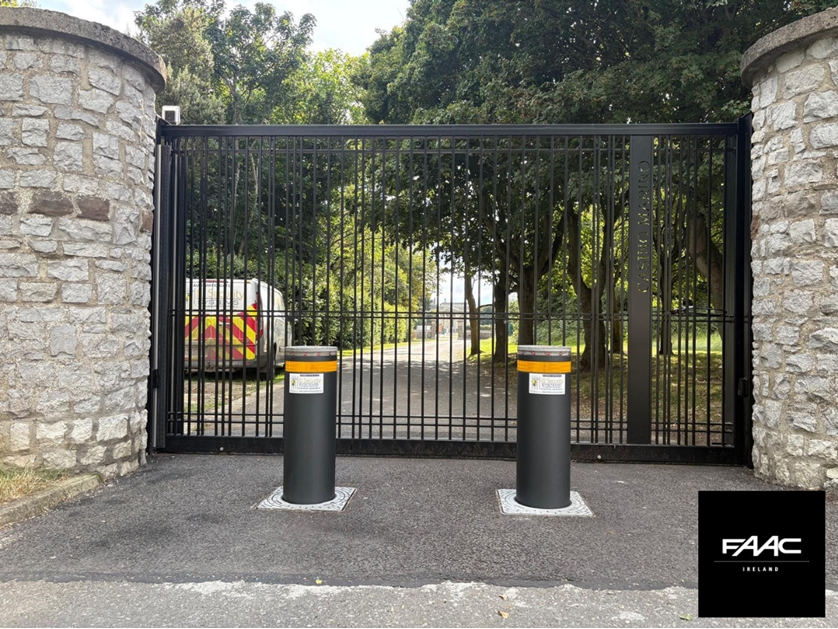
At the core of the solution is the FAAC 844 sliding gate operator at the main vehicular entrance, providing reliable and unobtrusive access control for gates weighing up to 1,800kg. This is complemented by two FAAC J275 automatic bollards, offering strong protection against unauthorised or hostile vehicles while maintaining a low-profile appearance. Safety edges, inductive ground loops, and programmable automation schedules ensure compliance with EU safety standards, controlled access during visiting hours, and rapid response capability when required. The finished installation delivers effective perimeter protection with minimal visual impact, preserving the character of the site while significantly improving security. The success of the project demonstrates how modern technology can be sensitively integrated into historic settings.
As noted by Ian Duffy of ID Security: “FAAC made the entire experience seamless from start to finish. They took the time to fully understand the root problem first, and then crafted a solution set that addressed our access control and security needs without compromising the site's historic nature.”